


























Deja vu Beneath the Soil: Will Nigeria's Rear Earth Rush Repeat the Oil Curse?
Ernest Omoarelojie
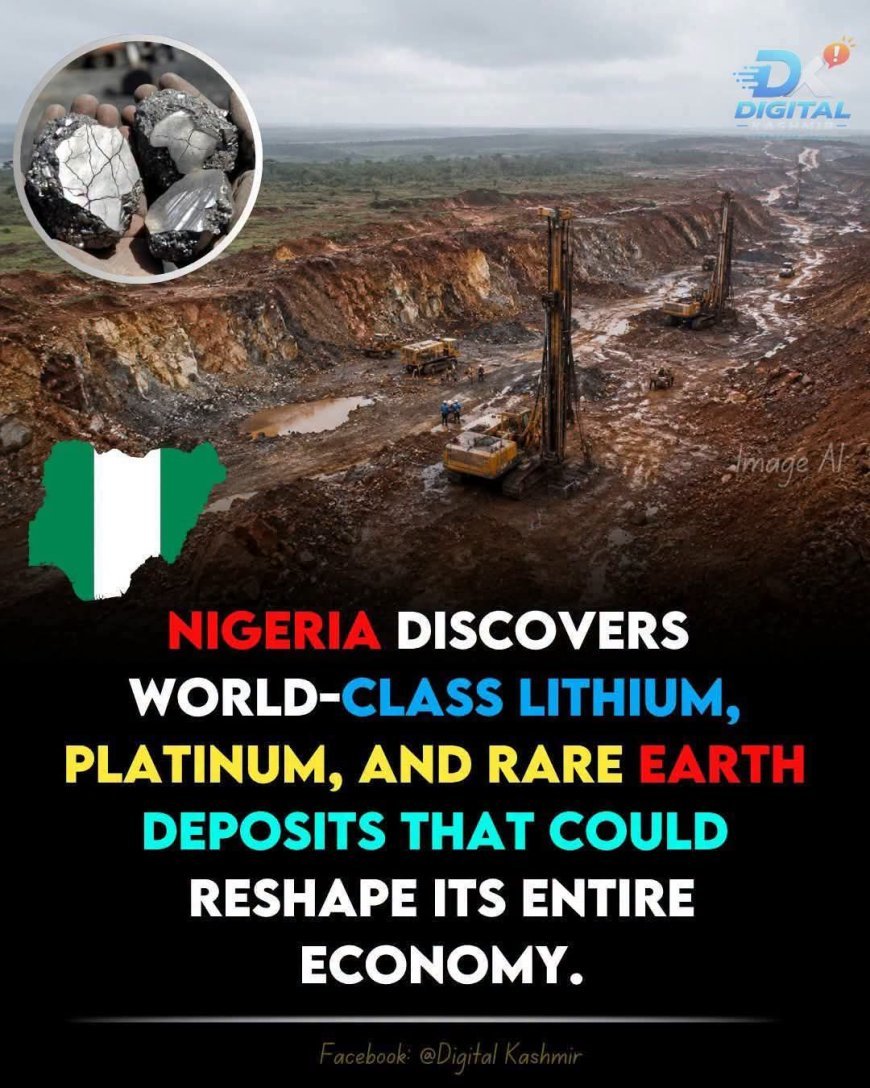
Six decades ago, Nigeria discovered crude oil at Oloibiri. Today it is rare earth elements-lithium, neodymium, praseodymium, cerium, lanthanum, etc., discovered in commercially significant quantities across Kaduna, Nasarawa, Kogi and at least nine other states. They are minerals whose name most citizens cannot yet pronounce. Like crude oil before now, they promise untold wealth beneath the soil that may finally lift the nation out of ongoing economic doldrums.
Somehow, we have been here before. But the question writing itself into the national conversation right now is unavoidable: is Nigeria about to relive the resource curse, this time in the language of clean energy and critical minerals? It is a familiar script that invokes negative nostalgia. Rather than being poetic licenses, the parallels are structural.
Like the manner crude was described as Black Gold upon its discovery, Nigeria's solid minerals sector has already been described in the local press as "Nigeria's next oil". The framing is disturbingly apt because it borrows the exact vocabulary that accompanied the discovery of crude-vast reserves, foreign investment, national transformation, economic transformation, etc, all of which did not turn out the way they were envisaged.
Dele Alake, Minister of Solid Minerals Development, has been very candid in positing that the federal government has been trying to avoid the original sin of the oil era-exporting raw commodity and importing refined value. That seems to be a wise step away from the mistakes of the past.
Apparently stemming from that decision, mining lease applicants are now required to submit local processing and value-addition plans before licences are granted. Thus far, more than 3,000 inactive or non-performing mineral titles have been revoked in an effort to restore discipline to a licensing regime that became a byword for opacity and elite capture in the oil sector. It would appear that there is real movement behind government rhetoric.
At the last check, a $400 million rare earth and critical minerals processing plant, touted as the largest in Africa's largest, is under construction in Nasarawa state. Also in the offing is an $800 million and another $600 million lithium processing investment. That is in addition to the $200 million lithium plant near Abuja, and a $1 billion iron-ore-to-steel project in Kogi.
Following the new drive, mining revenue has reportedly climbed from roughly ₦6 billion before the current administration to more than ₦70 billion by the end of 2025. For the first time in the history of this great nation, revenue from non-oil sector has surpassed that of crude, the nation’s traditional economic mainstay.
On paper, this looks like a government that has read the oil playbook very well and is determined to write a different ending. Nigerians only need to wait a while to see the outcome-whether it is a new dawn or Deja vu.
Old habits die hard, the saying goes. There is this strong feeling among observers that new mineral reality could reopen old wounds. In the main, this feeling cannot be wished off because several fault lines that deserve scrutiny still exist. For instance, the instincts that produced the Niger Delta crisis have not disappeared just because the identity of the source has changed. Among others, the processing is similar to what Nigerians had six decades ago.
At best, what is on ground is mostly a promise that could fall in any direction. For instance, the mineral production forecast for 2026, even with the optimistic projections of the federal government, fell short of the $27 billion GDP contribution target. The Nasarawa processing facility is privately financed and the financiers are not under any legal obligation to disclose its operations. Observers are particularly distressed over this, aware that the country’s refineries were built and rebuilt for decades but continued to export crude and import fuel.
Compared to the ongoing situation in the solid minerals sector, the gap between announcing a processing plant and operating one at scale is exactly where the oil sector's value leaked away for forty years. Yet, there is another issue that has to be sorted out-licensing opacity, which is an old but unattended bad institutional habit.
Whereas the revocation of thousands of dormant mining titles is a genuine reform, thanks to the Bola Ahmed Tinubu administration,, the fact that the oil sector also went through cycles of license sanitization that were later undermined by fresh rounds of opaque allocation to politically connected interests raises a lot of troubling concerns.
The glaring concern here is that nothing in the current mining reforms structurally prevents a repeat, beyond ministerial assurances. For example, the concerns for host communities seem to be an afterthought once again. No Nigerian can afford to forget the conflicts that followed “it is our oil” claims.
Rare earth and monazite extraction, particularly from heavy mineral sands, comes with radiological and water-table risks that are even more severe than conventional oil extraction. For years, the Niger Delta's fifty-year arc-from extraction to environmental degradation, militancy to an uneasy security architecture that still requires private contractors to protect pipelines. These are the cautionary tales Nigeria cannot afford to relearn in Kaduna, Nasarawa or Kogi. Yet the question is: will the ongoing afterthought not reignite the events of that sad past?
Commentary on the Kaduna discovery has already flagged it as both a national security challenge and an economic breakthrough. There are warnings too that unprotected mineral fields will attract organized crime and smuggling networks the way oil bunkering once did. The ugly trends are already unfolding. Are we ready to curtail it?
Revenue federalism is another troubling issue that remains unresolved. It is like a blast from the past that reminds us that crude oil revenue sharing between Abuja and producing states remains one of Nigeria's most persistent constitutional grievances today which forced the concession of the 13% derivation principle. With that still staring in the face, no comparable, tested framework exists for how that rare earth and critical mineral revenues will fare better between the federal government and resident states.
Lessons from history does not suggest that the issue will stay quiet for long even though there is a possibility that there could be a difference this round. Indeed, it would be unfair and inaccurate to suggest that nothing has changed. At least, there are three differences worth weighing seriously. Even though the US and other western powers are actively financing diversification, geopolitics is working in Nigeria's favour in a way it never did for oil as China currently controls an estimated 85% of global rare earth refining capacity.
Nigeria's Atlantic shipping routes, which bypass contested waters, and its membership in the African Continental Free Trade Area, give it leverage that (its oil-era, which competed in an already saturated) OPEC-governed market, never had.
Nigeria is not starting from zero on processing know-how. Decades of hydrocarbon refining, however troubled, have built domestic expertise in large-scale chemical separation, hazardous waste handling and continuous process control-skills with genuine technical overlap with lanthanide separation. For instance, the Dangote Refinery's emergence as a partial correction to Nigeria's refining failure is a proof that the country can close a value-chain gap it left open for decades.
The legal and institutional scaffolding is newer and deliberate, at least, on paper. The Nigerian Minerals and Mining Act, the mandatory local-processing requirement for lease applicants, and a federal minerals security task force, are instruments that simply did not exist when oil exploration began. But whether they are enforced with the discipline they're written with, is the real test.
Facts on ground suggest that the intent, at least on paper, is more self-aware than anything that accompanied the oil rush.
There is the verdict the data hasn't captured or written yet. That is the thrust of this piece. Properly understood, déjà vu, is not prophecy. It is a warning that pattern-recognition offers, not a fate that history imposes but that which can be altered. Nigeria's rare earth moment carries the same structural risks that turned crude oil into a curse rather than a blessing: raw-export bias, licensing opacity, host-community neglect, and unresolved revenue federalism. Yet it also carries advantages the oil era never had-a geo politically motivated buyer base desperate to diversify away from China, inherited processing expertise, and a slightly more self-aware policy architecture.
But whether Nigeria has actually learned from the Niger Delta, or has simply learned the vocabulary of having learned, will be visible within the next two to three years. The lessons will be available in whether the Nasarawa plant will ship processed material or concentrate; in whether host communities see development or degradation, and in whether the revenue-sharing question is settled before it becomes another Delta-style grievance.
Until then, the resemblance to crude oil's story is close enough that "déjà vu" is not a rhetorical flourish. It is the most precise word for what is happening.
Ernest Omoarelojie writes on Nigerian governance, communications and policy..
What's Your Reaction?